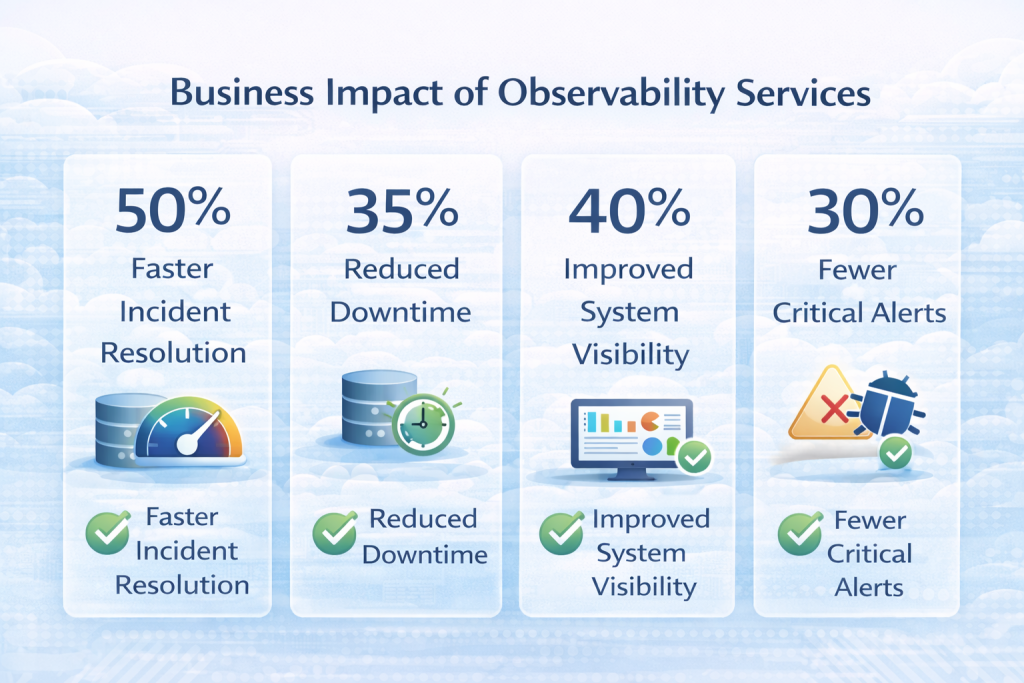
Unlock full visibility into your systems, reduce downtime, and improve reliability with Kybrix Observability & Monitoring Services — empowering teams across Auckland, New Zealand, Australia, and global enterprises to detect, analyze, and act on system signals in real time.
We provide proactive monitoring, comprehensive observability, and actionable insights so your platform runs smoothly — even in complex cloud and hybrid environments.
What Is Observability & Monitoring?
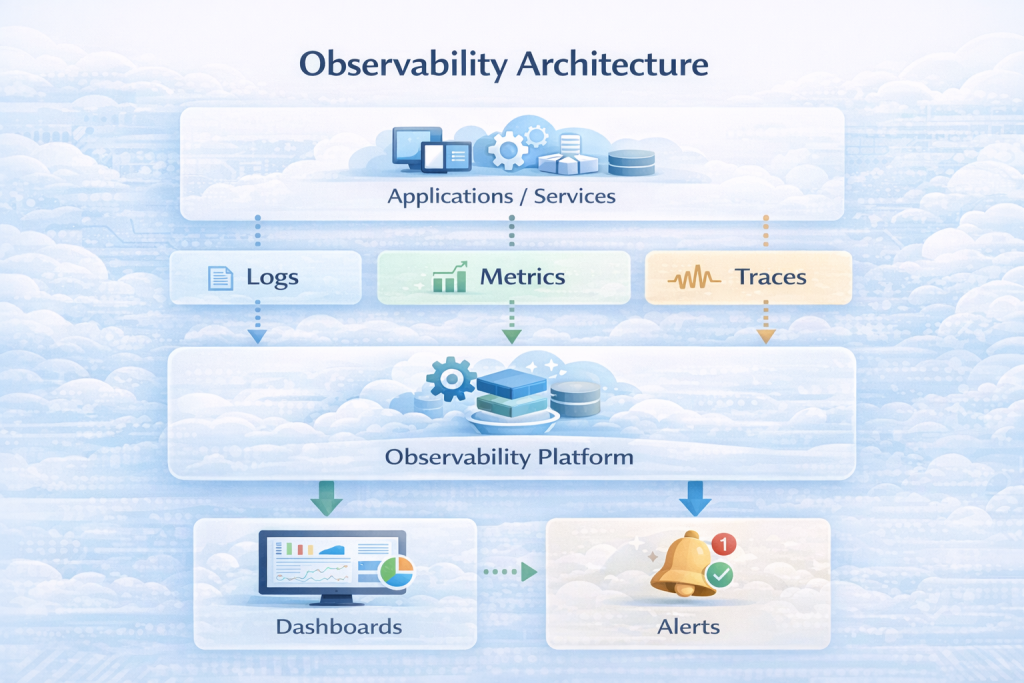
Observability is the ability to understand the internal state of a system based on emitted signals (logs, metrics, traces).
Monitoring tracks these signals to detect, alert, and respond to system events.
Together, they help teams:
Detect anomalies early
Diagnose root causes
Reduce mean time to resolution (MTTR)
Improve uptime and performance
In 2026, observability is critical for cloud-native environments, microservices, distributed architectures, and AI-driven automation.
Why Observability & Monitoring Matters in 2026
Modern systems are dynamic and distributed — spanning cloud, containers, serverless, and APIs. Without robust observability:
Issues remain undetected until they impact users
Performance bottlenecks are hard to isolate
Deployments carry unknown risk
Operations lack predictive insights
Google’s 2026 search updates prioritize content that helps teams solve real operational questions — this page is structured to directly answer those queries.
With real-time observability and analytics:
Teams get actionable insights, not just dashboards
Monitoring becomes preventive, not reactive
Alert fatigue is reduced through intelligent tuning
Reliability becomes measurable
Our Observability & Monitoring Services
End-to-End Observability Strategy
We help you define the right observability strategy:
Signal selection (logs, metrics, traces)
Tool evaluation and roadmap
Business impact mapping
SLOs, SLIs, and error budgets
Integration planning with existing systems
Implementation & Tooling
We implement observability tooling that fits your stack:
OpenTelemetry & vendor pipelines
Logging platforms
Metrics and dashboards
Distributed tracing
Alerting systems
Tools include (but are not limited to):
Grafana / Prometheus
Datadog
New Relic
Elastic Stack
Splunk
Custom Dashboards & Visualizations
Monitor what matters most:
Business KPIs + technical signals
Anomaly detection thresholds
Correlated traces and metrics
Real-time state views for ops teams
Dashboards are tailored to context — from executive overviews to deep technical drill-downs.
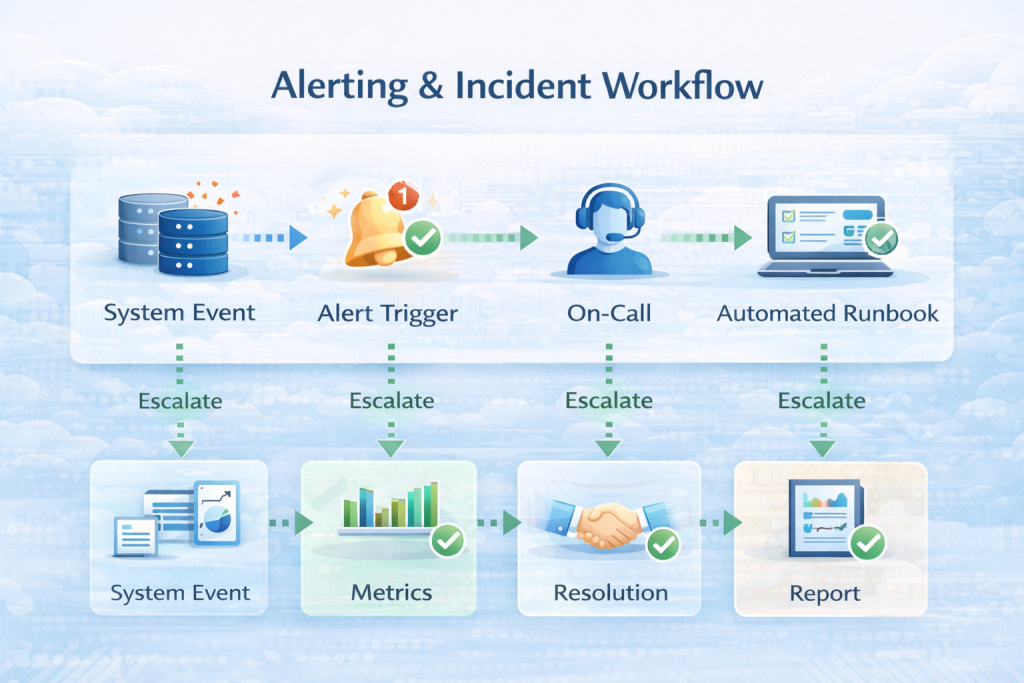
Intelligent Alerting & Incident Workflows
Reduce noise, increase signal:
Prioritized alerting setup
Escalation routing
Automated runbooks
On-call readiness
Feedback loops to improve alerts
Performance Tuning & Optimization
We help you uncover performance bottlenecks:
Latency issues
Error spikes
Resource constraints
Dependency chain latency
Service health baselines
Optimization improves reliability and user experience — and reduces cost.
Observability for Cloud & Hybrid Environments
Whether you’re on AWS, Azure, GCP, or mixed platforms, we ensure coverage across:
Compute layers
Containers & Kubernetes
Serverless functions
API gateways
Database performance
Our Delivery Approach
We follow a structured approach to observability success:
Discovery & Assessment – Evaluate systems, pain points, goals
Design & Roadmap – Define scope, signals, SLO targets
Implementation & Tuning – Deploy tools and refine alerts
Validation & Training – Validate signals and educate teams
Operational Support – Continuous monitoring, updates, insights
This ensures alignment between business goals and technical observability outcomes.
Industries & GEO Focus
Kybrix supports organizations across:
📍 Auckland & New Zealand
📍 Australia & Pacific Region
📍 Global Enterprise Environments
We work with teams across:
Tech & SaaS
Finance & FinTech
Healthcare
Retail & eCommerce
Logistics & Supply Chain
Professional Services
Local understanding of compliance, uptime expectations, and operational culture informs our delivery model.
Benefits of Observability with Kybrix
✔ Reduced downtime and outages
✔ Faster incident resolution
✔ Predictive performance insights
✔ Clear visibility across tech stack
✔ Contextual dashboards
✔ Business + technical alignment
Observability isn’t just monitoring — it’s operational intelligence.
Frequently Asked Questions
What is observability?
Observability is understanding system behavior based on emitted signals like logs, metrics, and traces — enabling teams to see what’s happening internally.
How is observability different from monitoring?
Monitoring alerts you when something goes wrong. Observability helps you understand why it happened by correlating multiple data sources.
What tools are used for observability?
Common tools include Grafana, Prometheus, Datadog, New Relic, Elastic Stack, Splunk, and OpenTelemetry — depending on your tech stack and goals.
How long does an observability implementation take?
Small to medium implementations typically take 4–8 weeks; larger, enterprise observability programs can take 8–14 weeks depending on system complexity and needs.
Does observability help in cloud environments?
Yes — observability is crucial for cloud, microservices, containers, serverless, and hybrid environments to ensure reliability and performance.
How do you measure success in observability?
Success is measured by uptime improvements, reduction in MTTR (mean time to resolution), fewer false alerts, and clearer operational insights.